
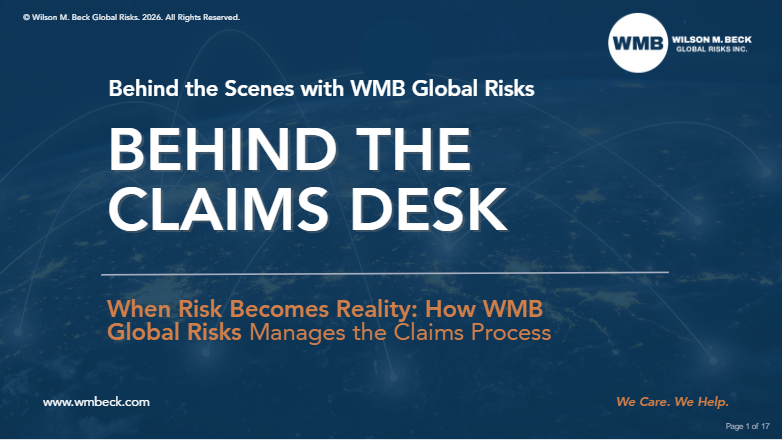
Behind the Scenes with WMB: Behind the Claims Desk
- Apr 7
- 6 min read
When Risk Becomes Reality: How WMB Global Risks Manages the Claims Process
Meet Wilson M. Beck Global Risks' Claims Specialist

Glen MacRae, BA, CIB
Executive Vice President
Wilson M. Beck Insurance Services, Burnaby, B.C.
With more than four decades of leadership in the Canadian insurance industry, Glen delivers deep technical expertise, strategic perspective, and a commitment to education and innovation that drives more informed, resilient decision-making.
As Executive Vice President of Wilson M. Beck Insurance Services and a strategic partner to WMB Global Risks, he leads initiatives in pre-claims preparation, claims advocacy, digital transformation, and professional development.
A recognized expert in broker E&O with experience before the Supreme Court of British Columbia, Glen has designed and implemented AI-powered solutions to streamline renewals, claims triage, and E&O risk mitigation. He has authored 35+ hours of CE-accredited curriculum delivered to over 300 professionals and developed the “Insurance 2.0” training series to advance digital fluency and governance in an AI-driven environment.
In 2025, Glen received the Insurance Business Canada Lifetime Achievement Award, recognizing his decades of leadership and lasting impact on the industry.
Sharing Our Expertise
Insurance programs are designed to respond to risk, but understanding how they perform in the real world is equally as important.
This document provides a practical view of the claims process, including how it unfolds, where complexity arises, and how claims are guided from loss to resolution.
While policies are structured at placement, claims introduce real-world variables: Multiple stakeholders, evolving facts, regulatory considerations, and the need for timely, accurate decision-making. Navigating this environment requires more than coverage; it requires coordination, technical interpretation, and strategic advocacy.
By looking behind our claims desk, organizations can gain a clearer understanding of how coverage operates under real conditions and the role that expertise and alignment play in achieving preferred outcomes.
To download the full document, click below

A Word from Glen
When speaking with organization executives or industry groups, I often describe the claims function as a form of quality control.
Having worked through tens of thousands of claims, I’ve seen how insurance performs when it matters most. I’ve learned that perspective doesn’t start at the point of loss, it informs decisions much earlier on - well before a policy is bound.
By working backwards from real-world loss scenarios, we help ensure that coverage is structured to respond as intended - before a claim happens. This approach also extends upstream, where our account teams are supported with a clear understanding of each client’s operational realities, ultimately allowing for the design of programs that reflect actual exposures, not just assumptions.
At its core, insurance is about preparing for what can go wrong so that when it does, the path forward is clear, coordinated, and effective.
Insurance is not simply about purchasing coverage and waiting for a claim to occur. It is about being proactive in the time between, taking the necessary steps before a loss so that when it happens, you are fully prepared – Glen MacRae
Claims: Where Insurance Becomes Valuable
Insurance programs are carefully designed during placement, but their true value is tested when a loss occurs. A claim is the moment when policy language moves from contractual wording to operational reality, requiring interpretation, documentation, and coordination to determine how coverage responds.
For multinational organizations, this process can involve multiple insurers, jurisdictions, adjusters, and regulatory requirements. Managing these moving parts requires more than policy placement. It often requires coordination, technical interpretation, and strategic advocacy to guide the claim toward resolution.
To understand how this works in practice, it helps to look behind the claims desk.
The First 24 Hours: Stabilizing the Situation
The first 24 hours following a loss are critical as it will shape how the claim is processes, coordinated, and ultimately resolved.

Translating the Policy
Turning coverage language into practical claims strategy requires technical interpretation and coordination across program structures.
1. Policy Triggers
Every claim begins with determining how coverage is activated.
Policy triggers define when insurance responds and which policies apply based on the nature and timing of the loss.
2. Deductibles & Coverage Structure
Deductibles, retentions, and layered policy structures determine how financial responsibility is shared between the insured and insurers.
Understanding these mechanics is essential to evaluating how a claim will be funded.
3. Local & Master Policy Interaction
In global programs, claims may involve both local admitted policies and a master policy structure.
Coordinating these responses ensures compliance with local regulations while maintaining consistent coverage across jurisdictions.

Managing the Claims Ecosystem
Claims rarely involve just one party and each party plays a very specific role in the overall process.

Each participant plays a specific role in evaluating and documenting the loss. Adjusters assess damage, forensic accountants analyze financial impacts, engineers evaluate structural or operational issues, and insurers review policy response.
Effective coordination helps ensure that information flows efficiently and that all parties are aligned on the scope and progress of the claim. Without structured communication and oversight, timelines can drift and outcomes can become more uncertain.
Where Complexity Multiplies
For multinational organizations, claims often involve additional layers of complexity. Regulations governing insurance claims vary significantly by country, affecting how policies respond, how payments are structured, and how adjusters operate.
Coverage structures may involve admitted local policies alongside global master programs, requiring coordination to ensure compliance with local regulations while maintaining consistent coverage across the organization’s footprint.
In practice, a loss in one country may trigger both local and master policy responses, requiring careful coordination to align coverage and facilitate recovery.
Areas that create additional complexities include:
Verifying consistent Coverage Across Organization
Meeting local Adjustor Requirements
Understanding Regulatory Reporting Obligations
Currency Considerations
Quantifying the Loss
Many claims extend beyond physical damage and require detailed financial analysis to determine the full economic impact of a loss.
Forensic accounting and operational analysis help translate disruption into measurable financial exposure, ensuring the claim accurately reflects the organization’s losses.


Why This Matters:
Accurate loss quantification directly affects the amount recovered under the policy. Clear financial modeling and documentation help insurers evaluate the claim efficiently and reduce the risk of disputes during settlement.
CLAIMS QUANTIFICATION PROCESS

Negotiation & Resolution
Claims resolution is rarely automatic. Insurers review documentation, assess policy interpretation, and evaluate the scope of the loss before determining settlement.
During this phase, the broker plays an important advocacy role, helping present the claim clearly, facilitating communication with insurers, and supporting the client through the negotiation process.
This process often involves ongoing dialogue regarding:
Coverage application
Supporting documentation
Valuation of damages.
Settlement timelines can vary depending on the complexity of the claim and
the availability of supporting information.

Lessons Learned After the Claim
A claim does more than resolve a loss event; it also provides valuable insight into how a risk program performs under real conditions.
Post-claim reviews often identify opportunities to strengthen future protection. This may include addressing coverage gaps, improving risk control measures, adjusting policy structures, or reassessing limits adequacy.
These insights feed directly into the next renewal cycle, allowing organizations to refine their risk strategy based on real operational experience.
Why Claims Experience Matters
Insurance placement is only one part of the risk management value chain. The true test of a program occurs when a loss happens, requiring partners who can both structure coverage and guide the claims process effectively.

Together, these capabilities help ensure that insurance programs function as intended when organizations face operational disruption.
Behind every insurance policy is a claims process. When that process works effectively, organizations recover faster and risk becomes manageable rather than disruptive.
Simplified Claims Process Timeline
Insurance is purchased at placement, but its value is delivered at claims.

WILSON M. BECK GLOBAL RISKS:
Your Partner in Exceptional Claims Handling
With decades of combined knowledge and experience in global trade credit and financial risk management, WMB Global Risks helps businesses protect revenue, manage credit exposure, and make informed credit decisions through tailored policies and proactive guidance.
To download the full document, click below
The Shi
Get the WMB Difference
Need Help?
Contact Wilson M. Beck Global Risks to discuss how to protect your business - wherever it takes you.
Wilson M. Beck Global Risks Inc. is a boutique division of Wilson M. Beck Insurance Services, offering tailored insurance and risk management solutions backed by over 100 years of combined experience.
Our team delivers personalized service rooted in trust, collaboration, and genuine care, ensuring every client feels understood, supported, and confident in their protection.
Our specialization in multinational insurance and corporate risk solutions is designed for mid-sized to large organizations that demand personalized service, specialized expertise, and seamless execution – wherever your business grows.
Contact Wilson M. Beck Global Risks to find out more about how our team of global experts can protect your operations and help keep you resilient, compliant, and in business.

We Care. We Help.


Comments